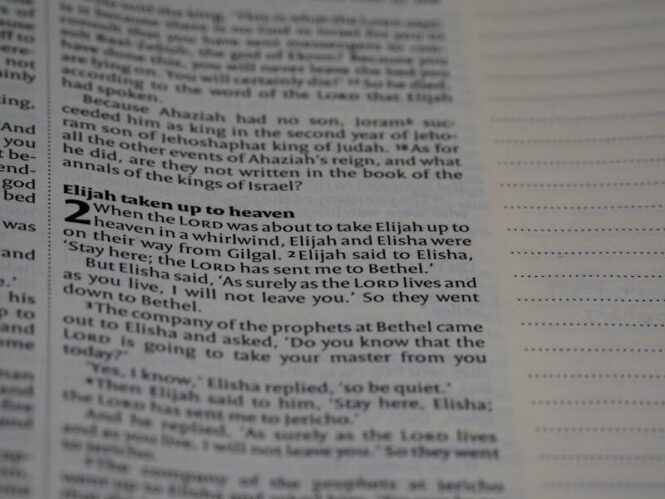
Like many, I can easily be gripped by the drama of the exploits of Elijah and Elisha. It’s an emotive story with powerful manifestations of God’s presence – and of course, there’s the mantle, angels, lots of rain, dead being raised, the chariots of fire and the double portion of anointing!
Much like others, I find myself profoundly captivated by the awe-inspiring ministries of Elijah and Elisha. Their stories are filled with deep emotional resonance, showcasing the awesome manifestations of God’s divine presence. The gripping elements—such as the transfer of the mantle, the chariots ablaze with heavenly fire and the double portion of anointing—serve as vivid markers of God’s active involvement in the lives of His prophets and, by extension, His people. They are not impotent tales of old but powerful reminders of the limitless power and grace that God extends to those who serve Him faithfully.
Behind much of the narrative is a conversation. We are privy to it, but unable to hear a word, not even a whisper, yet it is worth drawing one’s attention to it. 2 Kings 2:1-12 offers a profound depiction of the relationship between Elijah and Elisha. Their relationship was new but full of meaning. These prophets walked together, conversed, and maintained a relationship that was far beyond mere apprenticeship—it was covenantal. The scene is one of impending transition; Elijah’s time on earth is about to come to an end, and Elisha is on the cusp of receiving a double portion of Elijah’s spirit. Reading between the lines it’s not a normal event, so what did this mean and what did it point to?
Walk and talk
Walking together in the biblical sense often signifies more than just putting one leg in front of the other; it suggests a shared life, mission, and an alignment of purpose; Adam and Eve walked with God in the Garden of Eden, signifying close fellowship, Abraham walked before God in obedience and faith.
The simple act of Elijah and Elisha walking together is charged with theological implications. It’s not just a geographical journey from Gilgal to the Jordan River; it’s a spiritual venture underscored by commitment, mentoring, and the expectancy of divine action.
You’ll probably know the story by heart, but like everything in the scriptures, there is always something that avoids our attention. As they walk, Elijah tells Elisha to stay behind, but Elisha refuses. Here is Elisha now beginning to operate in his prophetic empowering or anointing – prophets on every side will offer their not very comforting words, but they are late to the party, Elisha already knows.
Elisha’s repeated response to Elijah, “As the Lord lives, and as you yourself live, I will not leave you” (2 Kings 2:2, 4, 6), speaks volumes about his commitment. He is aware. This day is not the same as yesterday. Something is about to happen, and Elisha is on to it. It’s more than loyalty; it’s a form of covenantal language. Elisha is expressing an undying dedication not just to Elijah but also to the mission that God has entrusted to them.
The persistent, relentless conviction of Elisha to never leave him elicits the modern reader to consider one greater than Elisha both in word and power who promised to never leave us, and more than that, never forsake us. (Hebrews 13:5)
An Expectancy of the Miraculous
Their walk culminates at the Jordan River, a site already ripe with spiritual significance. Elijah takes his cloak, rolls it up, and strikes the water. The waters part, allowing them to walk across on dry ground – a powerful, significant and divine endorsement of their journey and conversation.
The Mysterious “Double Portion”
Once they cross, Elijah offers Elisha anything he wishes before his departure. Elisha requests a “double portion” of Elijah’s spirit. As a young Pentecostal pastor this would grip my heart, but actually it isn’t about mathematical duplication but more likely refers to the inheritance a firstborn would receive. Elisha is asking to be considered the spiritual heir to Elijah, desiring to continue his work with even greater spiritual power. When Elijah is taken we’ll see a subtle expression of this…
Talking of which …
So, as the mood music changes and the two men of God walk along, what are they discussing? We don’t know, but we can guess…
Given Elijah’s experience of persecution at the hands of Queen Jezebel and the broader apostasy of Israel, their conversation likely touched on the spiritual crisis facing the nation. They could have delved into issues of faithfulness and endurance in ministry amidst hostility. Elijah might have imparted wisdom on navigating the treacherous waters of political engagement with a godless regime.
The weight of Elisha’s request for a “double portion” of Elijah’s spirit could have been a subject of deep discussion. Elijah might have clarified what such a request would entail—greater miracles, yes, but also greater responsibility and potentially greater suffering. The term “double portion” doesn’t only speak of abundance but is rooted in the responsibilities of firstborn inheritance within a family. This would be a momentous step for Elisha.
What about the past? Walks and talks are great for coming to terms with the past. We have limited accounts of Elijah’s early life and ministry before he burst onto the national stage in 1 Kings 17. There may have been personal anecdotes or lesser-known miracles that Elijah might have shared to encourage or instruct Elisha. These “untold stories” would serve not only as historical markers but also as spiritual lessons for Elisha’s forthcoming ministry including why Elijah walked across the ploughed field that day, and placed his cloak on him.
And in a similar manner to John 21:21 the subject of the prophets scattered on the hills may have arisen. Both prophets were connected to the prophetic community referred to as the “sons of the prophets.” Given that Elisha would inevitably take up a leadership role among these prophets, Elijah might have provided counsel on how to nurture, instruct, and mobilise this important spiritual community.
Given the urgency of the situation—Elijah’s imminent departure, the weight of Elisha’s request, and the spiritual-political climate—they were likely caught up in an intense, earnest conversation. The Hebrew word for ‘talking’ used in 2 Kings 2:11 can imply something deep and meaningful.
And so, the event concludes with Elijah being taken up into heaven by a whirlwind. Elisha receives the fallen cloak—a symbol of prophetic authority—and he returns to the Jordan, parts the water with the cloak, and steps into his new role with the double portion he requested.
Stop, look & listen!
Rewind, and pause for a moment and you will see something of significance. As they walk along chatting together Elisha is aware of the promise, if you see me go you will get what you asked for, if you take your eyes off of me, you’ll get nothing. Pressure! They walk together observed by the prophets at a distance. Suddenly, the moment arrives.
The scriptures gave no hint that either of them knew how the departure would happen, this was certainly no Uber or a Tesla ride. Notice Elisha’s immediate response: “And Elisha saw it and he cried, “My father, my father! The chariots of Israel and its horsemen!” And he saw him no more.” (2 Kings 2:12) Elisha calls out in earnest, “My father, my father” and whilst the prophets on the banks of the Jordan look on, the request for the double portion of inheritance comes immediately and powerfully.
So what? How does this affect me?
The journey of Elijah and Elisha offers us more than just historical or biographical insights; it speaks directly to us, inviting us to lean in and find layers of meaning in what might initially appear as mere details. When scripture says “And as they walked on and talked” it offers an invitation for us to consider the depths of our own spiritual relationships, commitments, and covenantal faithfulness with others—especially in this case, in the realm of prophetic ministry. These seemingly trivial bible comments are gold mines of divine wisdom, whispering that in every shared step and earnest conversation, God is forming us, shaping ministries, and preparing us for moments of divine encounter.
I encourage you to walk and talk with the same spiritual earnestness, ever mindful of the undercurrents of divine purpose running through the seemingly mundane aspects of our lives. You never know when the “heavenly Uber” might arrive!