I assume that you’ve read the narrative of Moses—you know the one—where Moses, lost in a daydream, wanders the desert, tending to his weary, bewildered sheep near God’s formidable mountain.
Echoes of Providence
In the wilderness of human bravado (“there must be some grass in this desert somewhere…”) and divine orchestration (“Hello, Moses? Look over here… and when you do, everything will be altered, transformed…”), the introductory story told in Exodus 3:1-5 reveals useful challenge and speaks of deep connections between the experiences of Israel in Moses’ day and for us in the Church today. Prepare to remove your shoes.
Names are important in the Biblical narratives, and no more so than for Moses’ parents, Amram and Jochebed. Both are of Hebrew origin with Amram meaning “exalted people,” and Jochebed’s name usually interpreted to mean “Yahweh is glory.” With such meaningful names to live up to and given the history we know of Moses’ birth we find ourselves also watching Moses with interest and intrigue. Mostly intrigue.
Moses’ Deliberate Choice
On a day entirely of his own choosing, Moses, the shepherd of Midian, led his flock-not nearby on the edge of the wilderness that was near to him-but to the far side of the wilderness, to Horeb, the mountain of God.
Why on earth would he choose such a distant, hot, barren landscape instead of a grazing patch close to hand? We can only speculate. This choice is obviously not trivial but looking back in retrospect, it has the familiar hallmarks of God’s providence. Today Moses, free to choose what to wear, what to eat, and where to go, makes his choice – and saying goodbye to his wife, takes his sheep off to the other side of the wilderness.
God’s unseen, compelling providential hand (or rather, His kettling) leads Moses to a place of solitude, to a place of encounter with God.
Like the Church today, the flock Moses led were in unfamiliar territory, a place not of comfort but of challenge, (likewise not far removed from our own journey of present-day spiritual dryness or difficulty and yet, holding the promise of renewal and revival) if you go far enough, even in the desert, there must be something worth eating.
Divine Presence & Revelation
This deliberate journey, short as it may have been on Moses’ part raises an important query; was it wisdom that drew Moses to the far side or just a momentary lapse of focus? The wilderness is typically not a place of comfort or abundance, but it seems to be a strategic choice by Moses without him knowing about it. Could it be that it was the lure of God’s Spirit, subtly leading him to a place of encounter, a place where vision is birthed and destiny is moulded? Things, odd things, happen to us in life – sometimes they are inconsequential, other times they are moments when suddenly we the sign, perceive the message or notice the writing on the wall. It can be that it is not until we ponder that God then begins to affirm and confirm what He purposed with and for us.
Eminem in his song, “Lose Yourself” throws out a challenge that even Christians can respond to:
“Look, if you had one shot or one opportunity,
To seize everything you ever wanted in one moment,
Would you capture it or just let it slip?
You better lose yourself in the music …
The moment, you own it, you better never let it go
You only get one shot, do not miss your chance to blow
This opportunity comes once in a lifetime,
You better lose yourself in the music
The moment, you own it, you better never let it go”
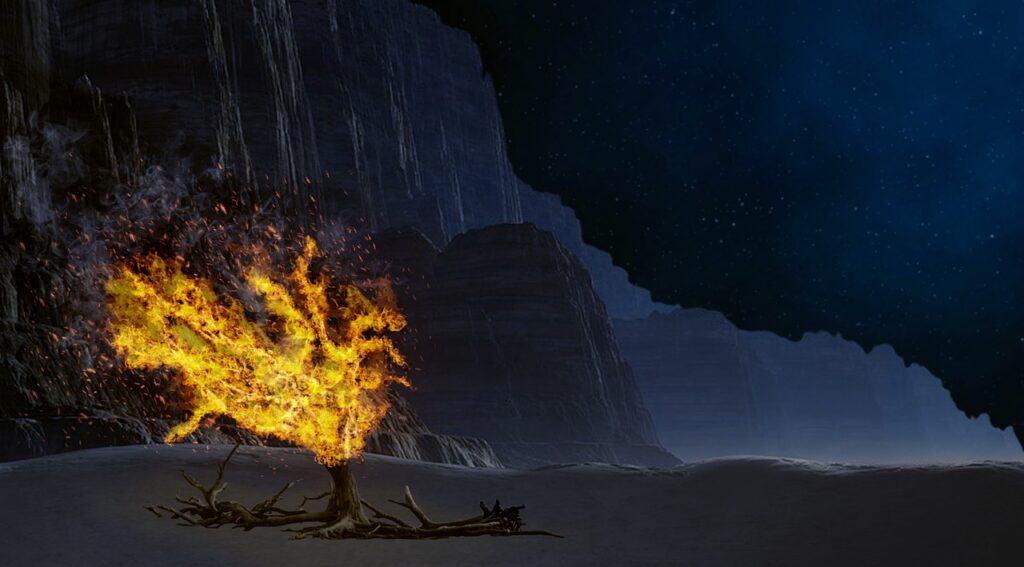
In the vivid vision of flames within the bush, a fire that burnt yet did not consume, there is for us a picture of divine presence and revelation. In the gospel, the Church today witnesses the fire of God’s presence, a fire that is transformative but does not consume our essence, a fire that purifies our intent and reveals our true identity in Christ. We are being changed, transformed, renewed and restored and yet, we are in constant need of the grace of God that sustains us and keeps us.
Reflections on Choice and Destiny
God, in His sovereignty, was watching Moses and when Moses turned to check out this amazing sight, God called out to him. But not until Moses was drawing near. God is watching you and knows how to get attention. Could history have taken a different turn if Moses had ignored this call? Only God can say, but it poses an underlying question of obedience and responsiveness to the call of God in our lives. Ignoring God’s call could have altered the trajectory of Israel’s destiny, much like our neglect to respond to God’s call can impact the destinies of communities and nations. We can speculate on much here, especially about divine ’cause and effect’ that has consequences beyond our imagination or comprehension.
The spiritual dynamics surrounding Moses’ encounter bear a fleeting semblance to Jesus’ journey into the wilderness, where he faced temptation, and subsequently, appointed twelve disciples. Divine commissioning and alignment of purpose are certainly to be read into this encounter.
Seeking the Divine in Desolation
The barrenness of the wilderness is both a place of testing and a place of impartation, and perhaps, maybe, hopefully, potentially… preparing the ground for revival. Mount Horeb and Mount Sinai are believed by some to be the same mountain, or at least located in close proximity to each other; either way, I have been to Mount Sinai and seen the supposed ‘bush of Moses’ at the foot of the mountain. In the ferocious heat of the midday sun it is a sight to behold, and my respect is with Moses as an 80 year old shortly managing to climb the rugged, unforgiving rocks to reach God.
For us as the Church, walking through our seemingly insurmountable seasons of difficulty, we are still encouraged by and drawn to visions of revival, of spiritual renewal and awakening. Having stumbled upon God (Remember the woman caught in adultery that gets pushed in front of Jesus and forgiven, though she had not asked for it) Moses averting his eyes, out of fear of looking at God, reflects our human inadequacy and reverence in the presence of the Lord. Shoes off. God was looking at him, a representation of divine grace and acceptance.
In times where the Church seems to be going through dryness, where the terrain seems barren, and the vision blurred, it is in this wilderness that God calls us to look beyond our fears and inadequacies. Nothing is gained by looking at the hostile environment we face; instead, we are called to gaze upon Him, to see the unburning bush, to hear the whisper in the wind, to discern the direction in the stillness, and to be moulded in the fire of His presence. Our God is holy.
As Christians we have a remarkable encouragement in Acts 17:26-27 (NIV): “He made from one man every nation of mankind to live on all the face of the earth, having determined their appointed times and the boundaries of their habitation, that they would seek God, if perhaps they might grope for Him and find Him, though He is not far from each one of us.”
This way of thinking supports the idea that every part of existence is carefully and purposely arranged by the Lord. Every moment and every situation are linked, meant to bring our hearts closer to Him, prompting us to seek and learn more about our purpose in life – with the full certainty that “all things work together for our good”.
Just as Moses couldn’t ignore the divine phenomenon, the Church today is challenged to respond to God’s call amidst the desolation, to be the voice in the wilderness preparing the way for a great move of God. The pursuit is not just for sustenance in barrenness but for the fulfilment of divine visions of revival.
This journey of Moses is a clarion call for the Church to embrace the wilderness experiences, to seek God in the barren places, and to respond with courage and obedience to His call, positioning ourselves in step with His purpose and working alongside Him in this divine commissioning.
Exodus 3:1-5 is not the great story that unfolds as we see a nation humbled and a nation finding its identity in God. Miracles will abound, great salvation will be seen as will healing and provision as well as dreadful judgment. Nations will shake in terror and dread before the awesome army of God, but ground zero is here, at the edge of the wilderness.
The bush that was “on fire” over there could have been ignored, but it wasn’t.