The story of Samson is one of the most intriguing narratives in Scripture. There is so much to consider with him – so the question, following previous posts is, “So what about Samson?”
He is introduced as a man set apart by God from before birth, gifted with extraordinary strength, yet marred by profound weaknesses. His life reflects the tension between divine calling and human frailty—a tension many of us may feel in our own lives at one time or another. Despite his glaring flaws, Samson’s inclusion in the “Hall of Faith” in Hebrews 11 offers profound insight into the grace of God and how brokenness in His hand can ultimately serve His purposes.
The Call and Gift of Samson
From the very outset, Samson’s life is marked by divine intervention. His birth is foretold by an angel to his mother, a woman previously barren (Judges 13), with the declaration that Samson will be a Nazirite from the womb, set apart for God’s purposes. Although we are not fully told what this would entail, as the story unfolds it becomes apparent that this is a special child. You may recall another child with a similar calling who, in his thirties, would be called the greatest prophet by Jesus.
The Nazirite vow, outlined in Numbers 6, involved abstaining from wine, avoiding contact with dead bodies, and not cutting one’s hair. These were outward signs of inward dedication to God, and certainly, this very hairy man would stand out in any crowd. It’s certainly not a call I am called to!
Samson’s incredible strength is the most visible manifestation of his divine gifting. Time and again, we see him perform incredible feats, from tearing apart a lion with his bare hands to slaying a thousand Philistines with the jawbone of a donkey (Judges 14:5-6; 15:14-15). This physical prowess was not merely for Samson’s own benefit; it was given to powerfully deliver Israel from the oppression of the Philistines.
But, and there’s usually a ‘but’ in these stories, alongside this strength, Samson is also a deeply flawed individual. His life is riddled with poor decisions, moral failings, and a penchant for reckless behaviour, with no consideration for the consequences. He breaks his Nazirite vow on multiple occasions, particularly by touching dead bodies and engaging in relationships with Philistine women, which were expressly forbidden (Judges 14:8-9; 16:1-4). The very things that set him apart—his strength and his calling—are the areas where he stumbles most profoundly.
The Shortcomings of Samson
Samson’s life is a stark reminder that even those called and gifted by God are not immune to temptation and sin. His primary weakness is his lack of self-control, particularly in matters of the heart. He struggles and struggles with it. His relationship with Delilah is the most infamous example of this. Despite knowing that she was aligned with the Philistines, Samson is captivated—perhaps even besotted—by her beauty and charm. His judgement becomes severely clouded, leading him to eventually reveal the secret of his strength—his uncut hair.
This revelation leads to his downfall, with Delilah immediately betraying him. She cuts his hair while he sleeps, allowing the Philistines to finally capture him, gouge out his eyes, and bind him in chains (Judges 16:17-21). It’s a tragic moment, not just because of what happens to Samson physically, but because it symbolises the spiritual and moral blindness that had plagued him throughout his life. The man who was meant to deliver Israel is now powerless and humiliated, enslaved by the very people he was supposed to conquer.
Yet, just as you expect the final credits of the film to roll, even in this moment of utter defeat, there is a glimmer of hope. The Bible notes, almost in passing, that “the hair of his head began to grow again after it had been shaved” (Judges 16:22). This detail might seem minor, but it is superbly rich with symbolic meaning. It hints at the possibility of restoration, even when all seems lost. It’s a twist in the story that no one expected. Samson’s hair growing back is a subtle reminder that God’s purposes are not thwarted by human failure.
A Broken Vessel Made Useful
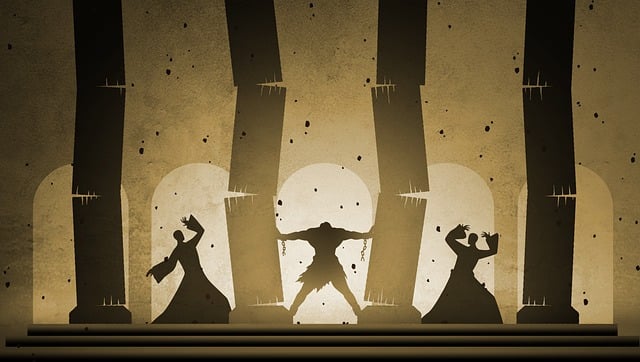
In the final act of Samson’s life, we see the ultimate paradox: his greatest victory comes unexpectedly (for us at least) at the moment of his greatest weakness. Blinded and bound, Samson is brought into the temple of Dagon to entertain the Philistines. It’s a scene of utter humiliation. But at this lowest point, Samson turns back to God. He prays, “O Lord GOD, please remember me and please strengthen me only this once, O God, that I may be avenged on the Philistines for my two eyes” (Judges 16:28).
Samson’s prayer is one of seeming desperation, but it’s also a moment of profound faith, where he finally recognises that his strength was never his own; it was a gift from God. In this final act of surrender, responding to brokenness, humility, and faith, God hears his prayer—and answers. Samson, placing his hands on the pillars of the temple, pushes with all his might, and the temple shudders, shakes, and collapses, killing more Philistines in his death than he had in his life (Judges 16:29-30).
This act of self-sacrifice is where we see the redemptive edge of Samson’s story. He dies with the Philistines, but in doing so, he accomplishes what he was called to do—begin to deliver Israel from their oppressors (Judges 13:5). His death, though tragic, is not in vain. God uses Samson’s brokenness, weaknesses, and even his failures to fulfil His sovereign purposes.
The Triumph of Grace
Samson’s inclusion in Hebrews 11, the chapter often referred to as the “Hall of Faith,” might surprise us. After all, Samson’s life was marked by so many failings. Yet, the writer of Hebrews commends him, along with others, “who through faith conquered kingdoms, enforced justice, obtained promises, stopped the mouths of lions” (Hebrews 11:33). Samson, despite all his flaws, is held up for us today as an example of faith.
Everything we have just considered tells us something profound about the nature of faith and the grace of God. Faith, in the biblical sense, is not about perfect obedience or moral perfection. It’s about trusting in God’s power and promises, even in the midst of our worst weaknesses and failures. Samson’s life was unmistakably far from exemplary, but in his final act, he demonstrated a faith that looked far beyond his circumstances to the God who is able to save.
In the church today, God’s grace is most evident in the way He uses flawed individuals like Samson to accomplish His purposes. This doesn’t excuse sin or minimise its consequences, and it never should. Samson’s life was marked by suffering that was often a direct result of his own choices, but it does highlight the present reality that God’s plans are not dependent or contingent on our human perfection. On the contrary, God delights in using the weak and the broken to showcase His strength and glory.
Brokenness and Redemption in Our Lives
The story of Samson resonates deeply because it mirrors our own experiences. We, too, are called and gifted by God, yet we often find ourselves stumbling in areas of weakness. While we may not possess Samson’s physical strength, we do know the weight of temptation, the pain of failure, and the sting of regret.
Our failures are not, nor ever will be, the end of the story. God’s grace assures us that He is a God of redemption. In Christ, our sins are forgiven, and our brokenness is not a barrier to God’s purposes but the very means by which His grace shines brightest. Paul writes about his own experience with the Lord in which the Lord responded, “My grace is sufficient for you, for my power is made perfect in weakness.” Paul’s response was, “Therefore I will boast all the more gladly of my weaknesses, so that the power of Christ may rest upon me” (2 Corinthians 12:9).
We should not be complacent about our shortcomings or indifferent to sin—we are responsible for our walk with God. Samson’s life reminds us of the serious consequences of living outside of God’s will, but it also means that when we do fail (and we do or will), we can turn to God in repentance, knowing that He is faithful to forgive and restore. Samson’s final prayer, offered in the midst of his brokenness, was heard by God, and in the same way, our prayers, offered in humility and faith, are received by a God who is rich in mercy.
The Gospel of Grace
The story of Samson ultimately points us to the greater tension of the gospel—that at the heart of the Christian faith is the truth that life comes through death, strength through weakness, and victory through apparent defeat. Jesus Christ, the perfect and sinless Son of God, was crucified in weakness, yet it was through His death that the powers of sin and death were defeated. His resurrection is the ultimate triumph of God’s grace, showing that even the greatest brokenness—death itself—can be redeemed.
Strength in Weakness
For you and me, Samson’s life is a testament to the reality that God’s purposes are not thwarted by human frailty, encouraging us to trust in God’s grace, even when we have failed. Our identity is not defined by our mistakes, but by God’s calling and gifting, and it points us to the truth that, in Christ, our weaknesses are not a liability but an opportunity for God to display His immense power.
What can we take away from this? In the end, Samson’s story is not about a strong man who was ultimately defeated; it’s about a broken man who was ultimately redeemed. And that is a story we can all find hope in.
As we navigate our own paradoxes of strength and weakness, we need to encourage one another to lean into the grace of God, trusting that He is very able to bring beauty from ashes, strength from weakness, and life from death.
For everyone in the Church, but also for our friends and neighbours, this is the gospel of grace—the good news that in Christ, brokenness can indeed be made good.