The Battle is the Lord’s

But He might use you …

person standing on rocky shore during daytime

Turn on your television and look at the new channel. Wars rumble across continents, the skies seem heavier with each passing headline, and somewhere between the chaos of collapsing economies and another broken promise from another broken system, people are growing weary. It’s not just the world that feels like it’s groaning – it’s us. Hearts are heavy. Fear sits close. And for many, the future feels more like a battlefield than a hope.

That’s why stories like David and Goliath still carry weight – not as sentimental fables for Sunday mornings, but as anchors for the soul when the storm clouds rumble in. The valley of Elah wasn’t a metaphorical battlefield – it was dust and sweat, breath and blood.

Watching nearby, witnessing the noise and tension of the battlefield, was David – youngest son of Jesse. He’s not a soldier or a warrior, just a delivery boy with grain, bread and cheese in his pack for his brothers, but his heart burned with something more and as he stepped closer, he could see the giant’s sneer, smell the sweat and tension in the air and hear every word of defiance hurled at the people of God.

And right there, we see the moment for what it truly is. The sling and stones may catch our eye, but they’re not the point. The real story isn’t about what David held in his hand—it’s about the God who held David. The One who goes before, who fights our battles, and who calls ordinary shepherds into extraordinary moments of faith.

1 Samuel 17 tells of a shepherd boy appearing like an Amazon delivery driver with roasted grain, ten loaves of bread and ten cheeses stepping into a moment no one thought he belonged in. Saul saw a boy. Goliath saw a joke but heaven saw a vessel – a heart aligned with the living God. “You come to me with a sword and with a spear,” David said, “but I come to you in the name of the Lord of hosts, the God of the armies of Israel” (1 Samuel 17:45, ESV).

And that’s the heart of it. This wasn’t David’s battle. It was the Lord’s.

We often approach life thinking we need to be enough – strong enough, strategic enough, spiritual enough. David wasn’t enough in himself. He knew that. His strength wasn’t in his skill; it was in his surrender. He didn’t face Goliath to prove his worth. He stood because he was already confident in God’s worth – His authority, control, and unshakable presence.

That’s what Lordship means. Not simply that God is high and lifted up – though He is. But that He is near. Present in the fight. Supreme over every threat. Sovereign in every valley.

Grace isn’t the cushion that catches us when we fall short – it’s the power that carries us when we step out. David didn’t earn divine favour by courage. Courage came because he trusted in divine favour. That’s what grace does – it meets us where we are, not where we should have been. That’s a challenge – your challenge.

The same Lord who spoke creation into being stood behind David that day, not as a distant deity, but as a covenant-keeping God, faithful to His people. He’s the same God who goes with you too, never missing a step.

We all face “Goliaths” and most of them don’t wear armour or shout curses from hilltops. They whisper in offices, in places you don’t want to be, in sleepless nights. They say, “You won’t make it.” “You’ve failed too many times.” “You’re not enough.”

That’s where prophetic ministry often steps in bringing criticism and encouragement; ‘this is not how things were meant to be’ God has not forgotten you, don’t give up!’

Those giants forget who your God is and in response for us the apostle Paul asserts, “If God is for us, who can be against us?” (Romans 8:31). Not hypothetically – for real. If the God who did not spare His own Son is with you, what threat remains that can unseat His purposes? Grace is not a flimsy sentiment – it is the hard-won gift secured by Christ, our Champion, who disarmed the rulers and authorities and put them to open shame (Colossians 2:15).

Christ, the true and better David, didn’t simply face a giant – He faced death itself. And through His cross, He conquered every enemy. That’s not poetic, it’s reality. And because of Him, we don’t fight for victory – we fight from it.

That means your weakness isn’t a liability. It’s a context for grace. Your fear doesn’t disqualify you – it’s the backdrop for faith. And your future isn’t fragile – not when it rests in the hands of an omnipotent God who works all things according to the counsel of His will (Ephesians 1:11). That’s your encouragement for 2026.

So yes, step into the valley. Not because you’re fearless, but because the Lord is present. Not because you have it all figured out, but because He holds all things together. This isn’t about trying harder. It’s about trusting deeper.

Courage is not the denial of danger; it’s the defiance of despair in the presence of divine authority.

David’s victory wasn’t the result of his boldness. It was the fruit of grace and the manifestation of God’s Lordship – His authority over the giant, His control over the battle, and His presence with the shepherd. For you.

That same Lord reigns today. And He has not changed.

Couldn’t resist it: 1 Samuel 17:17–18 – David took cheeses with him to fight Goliath!

Stop! rewind…

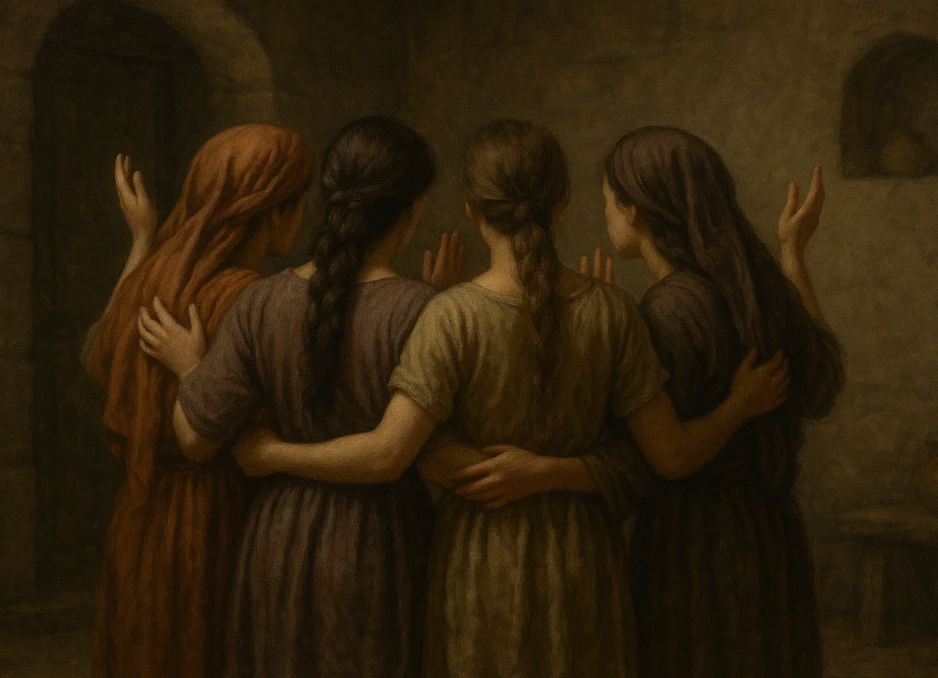
Philip’s four unmarried daughters, who prophesied

Picture by J. A. Hanton

As we follow Paul’s journey to Jerusalem and his stay at Philip the evangelist’s house in Caesarea, it’s easy to skim over a brief line – just seven words in Acts 21:9: “He had four unmarried daughters, who prophesied.” Nestled between the movements of Paul’s mission, it’s a short verse that holds a profound glimpse of Spirit-filled ministry – quiet, powerful, and enduring.

Philip the evangelist had settled in Caesarea, his itinerant days behind him, and into his home walks Paul, on the brink of arrest and hardship. It’s here we’re told of these four young women. No names given. No details of their prophecies. Just a simple, potent truth: they prophesied, and then the story moved on – but not for us. We’re pressing the pause button.

Now, we may want specifics – what did they say, to whom, when? Which daughter was the most accurate? How did they see, hear, know? Scripture doesn’t tell us. But their presence speaks volumes. They are there, present, large as life. These women operated in a prophetic gifting recognised by the early church. They weren’t anomalies; they were standard-bearers, modelling what the Spirit was doing in homes, not just synagogues.

The timing is significant too. Paul is heading to Jerusalem, a city simmering with tension. His path will lead to chains, trials, and eventually Rome. These daughters likely spoke into that trajectory – words shaped by the Spirit for a church on the move.

Their prophecies weren’t sideshows. They were mission-aligned, Spirit-breathed utterances likely shared within the household or in gatherings among the faithful. Not dramatic performances, but Spirit-led insight anchoring the church’s forward movement. The church hadn’t yet drifted into rows of polite silence – where spiritual gifts are explained away with a shrug, or dulled down in the name of being seeker-friendly. This was no environment of cautious irrelevance or legalistic restraint. God was at workin homes, in lives, in real time. In that atmosphere of faith, obedience, and raw trust, heaven wasn’t quiet. The Spirit spoke.

And right in the thick of it stood Philip’s four unmarried daughters. They didn’t just dabble in prophecy – they embodied it. Hearing, seeing, discerning… they prophesied, and they did so with such clarity and frequency that no one had to be told. It wasn’t just a reputation. It was known. “Philip’s girls? The four of them? Oh, they prophesy.” They raised the bar – lives marked by revelation, grounded in devotion, flowing with the voice of God.

Their singleness is no throwaway detail. In the ancient world, an unmarried woman carried less social clout, yet Luke highlights it. Why? Because their lives were fully devoted to God’s purpose. Their singleness gave them freedom – not just culturally, but spiritually. They weren’t confined by domestic obligations. They were fully available. The point isn’t that singleness is superior, but that God calls people in every season and status to Himself — and uses them powerfully.

We also know from early Christian accounts that at least two of these daughters lived long lives and were sought out by believers for their wisdom. Eusebius, the Jewish historian, tells us that Papias, bishop of Hierapolis (around AD 60–130), knew and consulted with some of the daughters of Philip the evangelist. He describes them as extraordinary witnesses of apostolic faith – so trusted, in fact, that people travelled great distances just to hear them teach and affirm the gospel message.

They weren’t one-hit wonders. They were consistent, enduring voices – living witnesses of the resurrection life. When the dust of apostolic drama settled, these women were still speaking, still listening to the Spirit.

And that matters. Because what the church often misses today is this: prophecy doesn’t always need a microphone or a lectern. The Spirit works in kitchens, around dinner tables, in conversations before work or after Netflix. The next word from God may not come with a spotlight; it may come through someone we’ve overlooked – young, single, female, unnamed.

This passage offers no prescription, no checklist for who qualifies. Instead, it offers promise. The Spirit will fill whom He chooses. And when He does, gender, age, and social status become irrelevant. Joel prophesied it. Male and female. Young and old. Regardless of their career. Expect God to speak anywhere and at any time. To you.

We need to ask: do we make space for these kinds of voices? Are our homes spiritually alive, open to revelation, filled with expectation that the Spirit might speak – not just on Sundays, but on any given Wednesday evening (my home group night)?

The daughters of Philip, by example, invite us to take the Spirit seriously – not just in public, but in private. They challenge us to see singleness not as lack, but as possibility. They remind us that faithful prophecy is more than flair – it’s Spirit-alignment with God’s unfolding purpose.

So here’s the big call: foster environments where quiet voices are heard. Host homes where the Spirit is welcome. Don’t overlook the ones without titles or platforms, because in the household of God, every vessel yielded to the Spirit can carry the Word – and sometimes, it’s the overlooked ones who speak most clearly.

And that is no small thing. That’s the Gospel – inviting the unseen into the centre, turning ordinary homes into places where heaven speaks.

This is exciting!